

Leopard Shark: Beautifully Patterned Shark
The leopard shark is known for being one of the ocean’s most visually distinctive and recognisable sharks with their prominent black spots and saddles on a silvery-grey back and has been described by researchers as having a relatively docile temperament; thus, they are considered to be among the most non-aggressive shark species in existence. They inhabit areas ranging along the Pacific coast from Mexico up to Oregon.. The majority of an individual’s lifetime will be spent swimming over sandy beach areas, or shallow bays, or estuary systems, or kelp forest systems, etc., all within 100 feet deep.
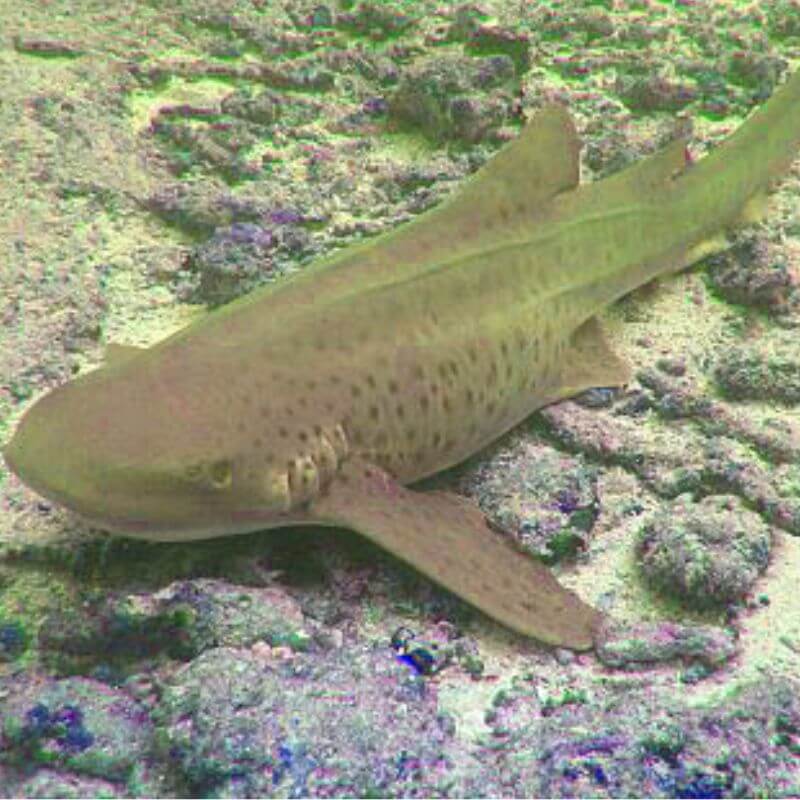
What Is a Leopard Shark?
The leopard shark (Triakis semifasciata) is one of the smaller members of the Hound Shark Family. It is called this because it has dark black spots all over its body, with a very distinctive dark-coloured “saddle” marking on its back that resembles those found on a leopard’s fur. Leopard sharks are unlike many larger predatory sharks, as they are very slow-moving fish and usually search for food along the ocean floor.
Fast Facts
- Common Name: Leopard Sharks
- Scientific Name: Triakis semifasciata
- Family: Triakidae (Houndsharks)
- Average Length: 1.2 – 1.5 meters
- Length Maximum: About 2 meters
- Weight: up to 20 kg
- Longevity: around 30 years
- Food Source: fish, crabs, worms, squid, and other small invertebrates.
- Conservation Status: least concern (worldwide).
Where Do Leopard Sharks Live?
The Leopard Shark has a natural habitat within the eastern Pacific Ocean. Their geographic distribution includes, but is not limited to, Oregon (occasional visits), Baja California, the Gulf of California (Mexico), and the state of California. They are most abundant in California and are found in shallow bays, estuaries, lagoons, mudflats, sandy beaches, and kelp forests. Leopard Sharks prefer this type of environment because it offers them both safety from other large predatory animals and abundant food sources. Unlike many other “pelagic” or open sea-dwelling species of sharks that typically remain in the deeper waters of the open ocean for all of their lives, the leopard shark rarely ventures into the open ocean at all, and typically remains close to shore.
Why Do Leopard Sharks Prefer Shallow Water?
The fact that many leopard sharks inhabit shallow, coastal waters with warmer water provides a reason why they are able to reproduce so well in this type of environment, as follows:
- There is an abundance of prey available for them.
- The water temperature is much warmer than in other parts of the ocean.
- The Eastern Pacific leopard shark can safely give birth to live pups in coastal bays.
- These bays typically do not contain many larger predator species.
Each year, many adult leopard sharks migrate back to the same bays where they were born, showing the remarkable ability to return to the same site each year (site fidelity). In addition, scientists have identified various populations of leopard sharks that remain within approximately the same area for several years, which is referred to as a home range.
How to Identify a Leopard Shark
One of the simplest ways to identify a Leopard Shark is by its distinctive body markings.
The key identifiers for a Leopard Shark are:
- A silver grey or bronzy colour
- Black “saddle” markings on the back
- Many small, rounded spots in a darker colour
- Slender elongated body
- Round snout
- The two dorsal fins of the shark are almost equal in size.
Each pattern of spots that each individual leopard shark has is unique; no leopard shark will ever have the same spot pattern as another.
Leopard Shark Size and Growth
Compared with many famous sharks, the leopard shark is relatively small.
Typical sizes include:
| Life Stage | Length |
|---|---|
| Newborn | 20–25 cm |
| Juvenile | 40–90 cm |
| Adult | 120–150 cm |
| Maximum | About 200 cm |
Females generally grow larger than males. Growth is relatively slow, and they reach sexual maturity only after several years.
What Does a Leopard Shark Eat?
Leopard sharks have been identified as “opportunistic” feeders and generally consume their prey on the ocean floor. The shark’s dietary base is made up of several items, including:
- Crustaceans (crabs)
- Shrimps
- Bivalve molluscs (clams)
- Marine polychaetes (marine worms)
- Small fish
- Anchovies
- Gobies
- Cephalopods (squid)
- Fish eggs
The leopard shark uses a feeding method that involves slowly patrolling the seafloor, using suction to extract prey from beneath the sand or silt rather than pursuing faster-moving prey. Its smaller, flat teeth are suitable for gripping slippery or smooth-skinned prey but would be too weak to tear larger animals apart.
How Does a Leopard Shark Hunt?
The sensory capabilities of the Leopard Shark are quite impressive, specifically:
A) Extremely good smelling abilities
B) Excellent sensitivity to detect very small amounts of electrical signals using their electroreceptors
C) Good visibility under water
D) Lateral line ability to detect vibration from objects around them
They do not ambush; instead, they slowly move along the seafloor (bottom-feeding), searching for prey hiding beneath the sediment.
Are Leopard Sharks Dangerous to Humans?
“Do Leopard Sharks pose a risk to people?” And the answer is No.
In fact, many experts consider Leopard Sharks as being among the safest shark species in the world.
There are reasons why this is so:
1. Small mouth
2. Gentle behaviour
3. Bottom feeding (they feed off the ocean bottom)
4. They tend to avoid humans
While they will occasionally swim close enough to swimmers, surfers or divers, they almost always exhibit non-aggressive behaviour. Documented instances of biting are extremely rare; typically, an accident resulting from unintended contact with the shark vs an unintentional attack.
Leopard Shark Behaviour
Leopard sharks are interesting because they exhibit social and behavioural characteristics rarely observed in other shark species.
Some interesting attributes of this behaviour include:
Social behaviour
Leopard sharks often congregate in large social groups that can be made up of dozens to thousands of individual sharks. These groups are typically composed of a single sex with members being roughly the same size.
Seasonal migration
Throughout the year, as water temperatures change, leopard sharks migrate into new coastal areas. During warmer times of the year, large numbers of them enter shallow bays.
Migration Patterns- Seasonal
In response to seasonal changes in coastal water temperature, leopard sharks migrate to different areas of the coast. In warmer months, when the coastal waters are warmest, many leopard sharks will enter shallower bays in large numbers.
Daily Routines
Generally, leopard sharks are diurnal but will eat at any time of day as long as food is available.
How Do Leopard Sharks Reproduce?
Leopard sharks reproduce viviparously; their developing offspring grow in utero, and they give live birth.
The reproductive cycle consists of:
1. Internal fertilisation
2. Development occurs internally.
3. Nutrients for growth will be supplied by a yolk sac.
4. Gestation will last about 10-12 months.
5. A female will give birth to the pups (live birth)
Births can range anywhere from four to thirty-seven pups per litter. Newborn leopard sharks are fully developed at birth and are capable of hunting small food sources right away.
Why Are Estuaries Important for Baby Leopard Sharks?
Young leopard sharks will spend many years developing in a sheltered environment with abundant food, then transition to larger coastal areas.
Predators of Leopard Sharks
These young sharks have limited natural predators. However, if no artificial barriers are in place, other predatory species that naturally prey on young sharks would likely feed on them.
The natural predator species include:
- Other larger shark species
- Broadnose sevengill sharks
- On occasion, sea lions
Amazing Leopard Shark Adaptations
Several traits that aid in the survival of the leopard shark are listed below:
Adaptation to Environment
The spotted appearance of their bodies is similar to what they see when swimming over a sandy bottom. It also helps blend with the rock formations.
Flexibility of Their Diets
Leopard sharks will eat whatever is available at a given time during different seasons.
Sensory Adaptations
Leopard sharks have electroreceptors that help them detect buried prey beneath the sand or mud.
Physical Energy Conservation
Because of their streamlined body shape, the leopard shark uses less energy than most fish to swim through the water while it cruises for food.
What Can We Learn from the Leopard Shark?
The fact that the leopard shark is a reminder of how many other types of sharks are out there, and how none of them has to be as scary as you see in movies. This species has developed beautiful patterns, is well-adapted to live on the seafloor, and shows us what a richly diverse group the shark family really is.