

Hammerhead sharks: an educational resource on the amazing ocean predators
The great hammerhead shark (Sphyrna mokarran) is possibly one of the most recognisable shark species globally. Due to its extraordinary head shape, this amazing predator has captivated both researchers and ocean enthusiasts alike for decades. Although its head may appear odd at first glance, every part of its body has been designed to make it an incredibly efficient hunter. Throughout the world’s tropical and subtropical oceans, great hammerhead sharks inhabit shallow coastal and open-ocean waters. In addition to helping control prey populations, apex predators contribute to the overall health of marine ecosystems.
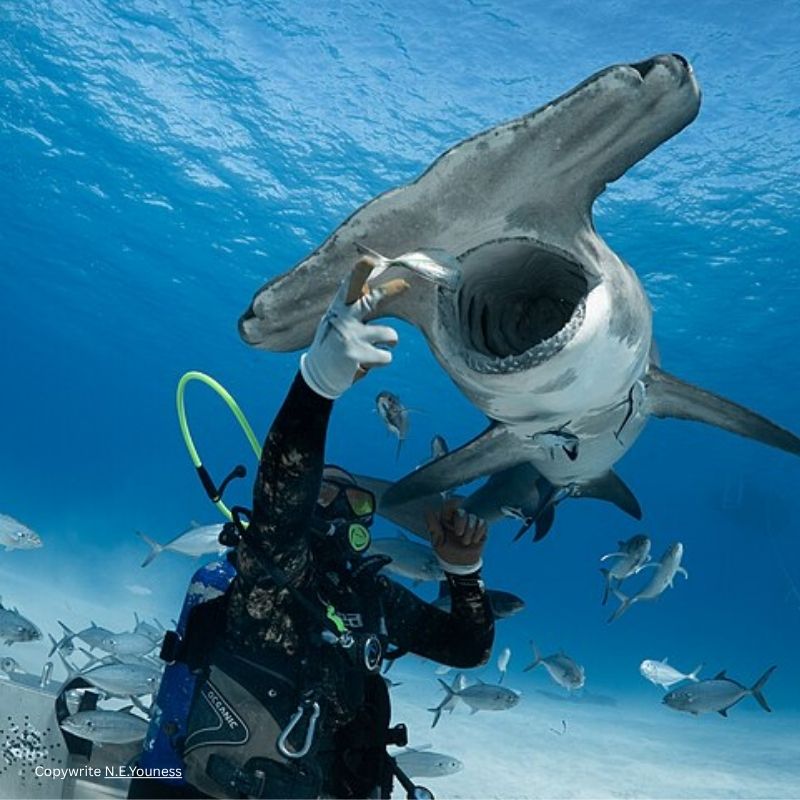
What is a Great Hammerhead Shark?
The Great Hammerhead Shark (Sphyrna mokarran) is the largest member of the Sphyrnidae (hammerhead) family. Alongside other members of the Sphyrnidae family (i.e., smooth hammerheads), there are several other types of hammerhead sharks; however, none grow larger than the great hammerhead or possess a more extreme head shape. The scientific term for the “hammer” portion of the head is called the cephalofoil. The cephalofoil provides several evolutionary advantages for the great hammerhead shark, including enhanced vision and improved hunting capabilities.
Why did the Great Hammerhead Shark develop a hammer-shaped head?
One question asked most frequently about the great hammerhead shark concerns why it developed such a distinctive head. Scientists believe the cephalofoil offers numerous advantages.
Better vision
Each eye of the great hammerhead shark is located at either side of the hammer, giving it an unusually wide-angle view. This means that great hammerheads can see what lies above and below them better than many other shark species.
Enhanced electroreception
Thousands of electroreceptors, called the Ampullae of Lorenzini, are located within the head of a great hammerhead shark. Each ampulla detects weak electrical currents generated by prey hiding beneath sandy substrates. Thus, great hammerheads can detect stingrays even when fully buried in sediment.
Greater mobility
The wide head of the great hammerhead functions somewhat like an underwater wing, providing additional stability and permitting quicker turns when pursuing prey.
Where do Great Hammerhead Sharks reside?
The great hammerhead shark is distributed throughout warm coastal and offshore waters in the tropical and subtropical regions of all the world’s major oceans.
More specifically, great hammerheads are often encountered in:
- Atlantic ocean
- Indian ocean
- Pacific ocean
- Near island-based marine ecosystems
- Along coral reef systems
- On Continental shelf systems
Great hammerheads tend to prefer warmer waters between 20°C – 28°C and occasionally migrate into colder temperatures during periods of seasonal migration. Unlike certain shark species, great hammerheads frequent shallow coastal areas before migrating to more remote open-ocean waters.
Dietary variety for the Great Hammerhead Shark.
Great hammerhead sharks primarily feed on a variety of organisms.
Specifically, preferred foods include:
- Eagle Rays
- Stingrays
- Small-sized sharks
- Bonefish
- Squid
- Octopus
- Crustaceans
One notable example of their predatory behaviour is their predation on stingrays. The shark uses its broad “hammer” to pin a stingray against a flat surface before taking a powerful bite. Stingrays’ barbed stings can inject venom into potential predators, but this does not stop these sharks.
How large may a Great Hammerhead Shark become?
The great hammerhead shark is the largest hammerhead species.
Average adult sizes include:
- Length: 3.5–5 m
- Weight: 230–450 kg
There have been exceptional examples that have grown beyond:
- Length: 6 meters
- Weight: greater than 450 kg
Female great hammerheads tend to be larger than male great hammerheads. As with many other shark species, female sharks are typically larger than male sharks.
Behavioural patterns of Great Hammerhead Sharks
For an animal of considerable size, the great hammerhead shark is generally solitary. Unlike scalloped hammerheads, which regularly school together, great hammerheads are typically solitary hunters.
Observational behaviours of the great hammerhead shark have included:
- Migration between summering/fattening areas & wintering/breeding areas
- Solo hunting
- Slow cruising along near-shore reefs
- Deep-dives into open ocean waters (Up to approximately 300 m)
While Scientists have reported dives as deep as 300 meters in open water, most of their time is spent in shallower waters.
Are Great Hammerhead Sharks Harmful to Humans?
As a formidable predator, the great hammerhead shark has extremely rare interactions with humans. As with all large shark species, it is best to show them respect, yet documented incidents of people being attacked by great hammerheads are infrequent. Most documented interactions occur when:
- People observing them from boats offshore
- When fishermen inadvertently hook them
- When they investigate unfamiliar items in their environment
Generally speaking, great hammerheads avoid interacting with humans whenever possible. Similar to all wildlife, people should never attempt to approach or interact with wild sharks in any way.
How do Great Hammerhead Sharks give birth?
Unlike the egg-laying (oviparous) reproduction habits of many other shark species, the great hammerhead shark reproduces via viviparity (live birth). After gestation of nearly eleven months, females deliver litters containing anywhere from six pups to more than forty pups. At birth, newborn pups display the typical soft & flexible version of the distinctive “hammer-head”, which will later become harder & more rigid in adulthood. Young sharks remain in coastal nursery areas for extended periods until they reach sufficient age and maturity to relocate to more distant areas rich in food and low in predatory competitors.
Adaptations of great Hammerhead Shark
Several adaptations permit great hammerhead sharks to be successful predators.
- Enhanced sensitivity to low-level electric fields – Low-level electric fields generated by hidden prey are rapidly detected by great hammerhead sharks.
- Sensitive sense of smell – All sharks have olfactory receptors that enable them to detect chemical compounds in seawater.
- Powerful jaws – Prey with hardened exoskeletons are successfully consumed by great hammerhead sharks due to their strong jaws. Additionally, great hammerheads can overcome stingrays with barbed spines that inject venom.
- Efficient swimming ability – streamlined bodies & high dorsal fins enable efficient swimming in open ocean waters, allowing for extensive distances to be travelled without excessive energy expenditure.
Comprehensive comparison amongst various types of hammerhead sharks, including the scalloped & smooth types
Aside from their greatly differing sizes, several physical characteristics distinguish the three main types of hammerhead sharks from one another.
| Feature | Great Hammerhead | Scalloped Hammerhead | Smooth Hammerhead |
|---|---|---|---|
| Largest species | Yes | No | No |
| Maximal length | 6 m | 4.3 m | 5 m |
| Extremely tall dorsal fin | Yes | No | Moderately |
| Normally solitary | Yes | Often schools | Sometimes school |
| Favorite food item | Stingray | Fish | Squid |
Explore More about Sharks and Marine Conservation
The Great Hammerhead Shark (Sphyrna mokarran) is one of the most impressive predators that exists in Nature. The unique form of this predator, its high level of hunting sophistication, and its fundamental role as an ecological player within the ecosystem make it an integral component of the health of all marine ecosystems. Learning how this species survives and supports itself, while also supporting conservation efforts, will help us maintain viable populations in our ocean for future generations. Regardless of whether you are a student, a marine enthusiast interested in marine life, or simply someone captivated by the beauty of wildlife in the ocean, studying the Great Hammerhead Shark is just another way to appreciate the diversity of life beneath the water’s surface.