The Great White Shark Decline Gansbaai Explained
The Great White Shark decline Gansbaai has become one of the most discussed marine conservation issues in South Africa. For decades, the small coastal town of Gansbaai was celebrated as the Great White Shark Capital of the World. Thousands of visitors travelled here annually to witness these iconic apex predators in the nutrient-rich waters of Shark Alley, between Dyer Island and Geyser Rock.
Today, sightings have dropped dramatically. Long stretches pass without confirmed Great White encounters, raising important questions about ocean health, predator behaviour, and the future of shark tourism in South Africa.
Understanding the Great White Shark decline Gansbaai requires examining several interconnected factors.
A Historic Hotspot for Great White Sharks
For years, Gansbaai offered one of the most reliable Great White Shark viewing locations on earth. The seal colony on Geyser Rock provided a consistent food source, attracting Carcharodon carcharias to the area.
This natural phenomenon helped transform the town into a global eco-tourism hub. Shark cage diving operations supported the local economy while shifting public perception — replacing fear with education and conservation awareness.
Around 2015, however, operators began noticing changes:
- Fewer sightings
- Shorter shark visits
- Extended periods with no Great Whites present
These patterns marked the beginning of what is now widely recognised as the Great White Shark decline Gansbaai.
Orca Predation and Behavioural Shifts
One of the most visible drivers behind the Great White Shark decline Gansbaai has been orca predation.
Since 2017, two male orcas — nicknamed Port and Starboard — have been observed hunting Great Whites in South African waters. Several shark carcasses have washed ashore with their livers surgically removed, a clear indication of targeted orca attacks.
Research suggests that when orcas enter an area, Great Whites temporarily abandon it. In some cases, sharks have stayed away for weeks or even months following orca activity.
While predation is a natural ecological process, the behavioural displacement of an apex predator creates ripple effects throughout the marine ecosystem.
Overfishing and Reduced Prey Availability
Great White Sharks depend on healthy populations of Cape fur seals, smaller sharks, and large fish species. Overfishing in South African waters has reduced prey availability, placing additional stress on the ecosystem.
Although Great Whites are legally protected, accidental bycatch in longline and gillnet fisheries remains a serious concern. Even low levels of unintended capture can significantly impact slow-breeding shark populations.
The Great White Shark decline Gansbaai cannot be attributed to a single cause — instead, it reflects cumulative environmental pressures.
Climate Change and Ocean Shifts
Climate change is altering ocean temperatures, currents, and prey migration routes. Subtle shifts in marine conditions may encourage Great Whites to relocate toward areas such as the Eastern Cape or KwaZulu-Natal.
Marine ecosystems are dynamic. Apex predators respond to environmental cues, prey distribution, and competitive pressures. Some researchers believe the sharks have not disappeared entirely — they have simply moved.
However, the local impact of the Great White Shark decline Gansbaai remains significant.
The Ecological Ripple Effect
Great White Sharks are apex predators. Their presence regulates seal populations and maintains balance among mid-level predators.
Without them, ecosystems can experience trophic cascades — where prey species grow unchecked, altering fish stocks and biodiversity patterns.
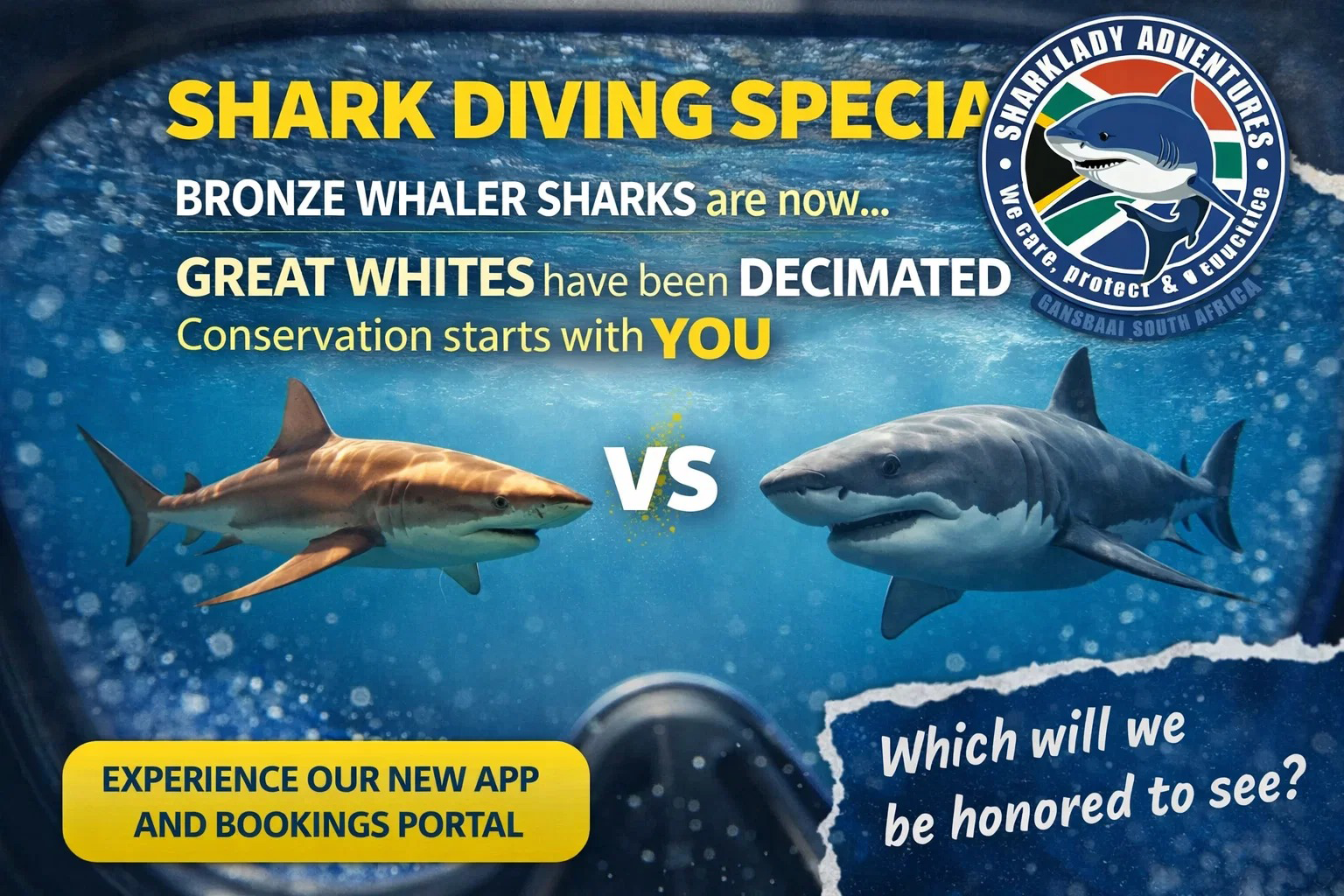
In Gansbaai, some operators report increased sightings of bronze whaler sharks filling the ecological gap. While impressive animals in their own right, they occupy a different niche within the food web.
The Great White Shark decline Gansbaai therefore extends beyond tourism — it reflects a broader shift in predator dynamics along the South African coastline.
What This Means for Tourism in Gansbaai
The decline in Great White sightings has naturally affected shark cage diving operations. Once known for consistent encounters, tours now adapt to a changing marine environment.
Fortunately, Gansbaai remains one of South Africa’s richest marine regions, offering:
- Cape fur seal colonies
- Abundant seabird populations around Dyer Island
- Seasonal whale migrations
- Dolphin pods and occasional orca sightings
Rather than focusing solely on Great Whites, tourism is gradually broadening to showcase South Africa’s Marine Big Five: sharks, whales, dolphins, penguins, and seals.
Responsible tourism remains central to long-term conservation. Visitors can learn more about ethical practices in our guide to responsible shark tourism South Africa.
Conservation Efforts and Ongoing Research
Despite the challenges, there is cautious optimism.
Organisations such as Dyer Island Conservation Trust and WWF South Africa continue to monitor shark populations and advocate for stronger marine protections.
Conservation efforts include:
- Scientific monitoring and tagging programs
- Bycatch reduction advocacy
- Marine Protected Area enforcement
- Public education initiatives
The future after the Great White Shark decline Gansbaai depends on coordinated action between researchers, policymakers, tourism operators, and the public.
Why Protecting Great Whites Still Matters
Great White Sharks symbolise wild oceans and ecological balance. Their decline serves as a reminder of how sensitive marine systems are to both natural and human-driven pressures.
Protecting Great Whites means protecting entire food webs, coastal economies, and biodiversity networks.
Marine ecosystems are resilient when given the chance to recover. With responsible fisheries management, continued research, and sustainable tourism, the story of the Great White Shark decline Gansbaai is not necessarily permanent.
Final Thoughts
The Great White Shark decline Gansbaai is the result of multiple overlapping factors: orca predation, overfishing, climate shifts, and human activity. While sightings have decreased, the situation reflects broader ecosystem dynamics rather than extinction.
South Africa’s oceans remain vibrant, complex, and worthy of protection. Through conservation partnerships and responsible marine tourism, there is still hope that Great Whites may one day return to Gansbaai in stronger numbers.
The ocean is constantly evolving — and so must our commitment to protecting it.